
NATIONAL MATURITY

The Apostle Paul states in First Corinthians 13:11, “When I was a child, I spoke like a child, I thought like a child, I reasoned like a child. When I became an adult, I put an end to childish ways.” So, as we are in this extra-special summer of the 250th Anniversary of our United States of America, I find myself thinking of this Bible verse in relation to where we are at in the overall life cycle of our exceptional democratic republic. For I am convinced that the basic process of maturation also applies to entire nations, not just to individual persons.

Generally speaking, when we were little children, we viewed our parents through an almost entirely positive lens. They could do nothing wrong in our eyes. Later, when we became adolescents and young adults, we tended to view our parents through an almost entirely negative lens. They could do virtually nothing right in our teenage and young adult eyes. And periodically during adolescence, teenagers will slip in and out of a childlike orientation toward their parents as they grow. However, if we had a loving and faithful set of parents, we then matured to realize in our full adulthood (usually around 25-30 years of age) that our parents are basically good and decent people (despite their various imperfections), and that they actually know a thing or two regarding the most important matters of life.

In a similar way, our United States of America has been in its adolescent phase of development for decades now as our national life has been marked by a great deal of adolescent-like angst about our national history, heritage and identity. So, while some Americans maintain a childish view of the USA as virtually doing no wrong in the world, there are many Americans who view the USA through an almost entirely negative adolescent lens.

Of course, the truth is that there’s no such thing as a perfect nation. All nations have negative aspects to their histories and present realities. Yes, our United States of America is not perfect, but our history and heritage are not a horrible travesty either. As my longtime colleague and friend, Pastor Jeff Spencer, recently wrote: “There is much to lament in American history, to be sure, but there is so much more to be grateful for.”

I would argue that the USA has been (by far) and continues to be (by far) a great blessing within our world. Therefore, it is indeed right and salutary that we should have a healthy sense of patriotism for everything that is good and laudable about our national founding, history, heritage and identity. While acknowledging the bad historical aspects, and learning lessons from these without falling into a kind of national self-loathing, we can make sure to uplift and give thanks for the great many good aspects of our nation. Moreover, it’s these numerous good aspects of our nation that our national symbols point toward and represent, particularly the US Flag. So, as we celebrate a quarter millennium of nationhood, I believe it is important to be mindful of the fact that our national inheritance is truly a great good overall — although we have at times failed to live up to our highest ideals enshrined in the Declaration of Independence, the Constitution, the Bill of Rights and the Federalist Papers.

I call this perspective a mature patriotism, and it is my hope and prayer that our country is heading out of our time of national adolescence into a time of national maturity concerning our founding, history, heritage and identity. While the far right and the far left of our sociopolitical spectrum both continue to agitate for a national culture of envy, victimhood and grievance that’s based upon false histories and conspiracies, I pray for a spirit of national wisdom and maturity to win the day.

“The counsel of the Lord stands forever, the thoughts of his heart to all generations. Happy is the nation whose God is the Lord…” – (Psalm 33:11-12a)

Happy Birthday America! God bless the USA! All glory be to the Lord God Almighty!

Grace & Peace, Pastor Tim
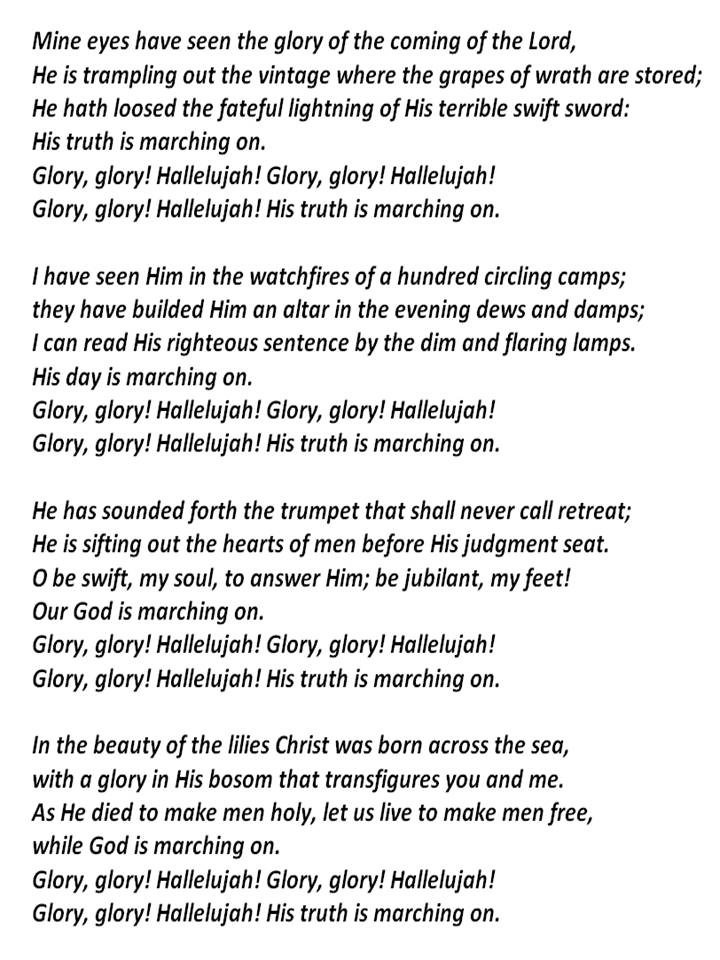
GLORY, GLORY! HALLELUJAH!

The Battle Hymn of the Republic is a hymn that became the semi-official Civil War song of the United States Army during that great civil conflict of our nation. It was written by Mrs. Julia Ward Howe, a poet and dedicated abolitionist, who visited an army camp near Washington D.C. in 1861. She was inspired by the soldiers singing “John Brown’s Body” which was a folk tune about an anti-slavery advocate who had been hanged for his efforts to free the slaves. Mrs. Howe felt that the catchy camp tune of this song should have better words along with it, and so she wrote her own lyrics to the same melody. The song expressed her support for Abraham Lincoln, who was elected President of the United Sates in 1860 and faced fierce opposition from the pro-slavery South.

Deeply anguished at the growing conflict between her fellow Americans, and in a desire to articulate her own feelings about the dreadful division of that time, Julia Ward Howe is said to have written her inspired verses almost without looking at the paper. The “Battle Hymn of the Republic” (a.k.a. “Mine Eyes Have Seen the Glory” and “Glory, Glory! Hallelujah!”) was first published in the Atlantic Monthly Magazine in 1862 as a battle song for the U.S. republic. Before long the entire nation became inspired by her text and united in singing the new words with the old tune.

I have to say, to have implicit trust in God’s faithful care and protection is never easy in times of danger or strife. Yet even in the midst of the terrible American Civil War between the United States and the Confederate States, a remarkable Christian woman named Julia Ward Howe proclaimed her confidence in God’s triumphant power for the ultimate good of all.

From the first time it was sung unto today, Mrs. Howe’s hymn has been acclaimed through the years as one of the finest national hymns of our United States of America. In fact, very early on it was sung as a solo at a large rally attended by President Abraham Lincoln himself. After the audience had responded with thunderous applause, the President (with tears in his eyes) cried out, “Sing it again!!” So it was sung again… And after more than a hundred and fifty years, patriotic Americans still join in singing with one voice, “Glory, glory! Hallelujah! His truth is marching on.”

May you all have a very happy Fourth of July and a deeply rejuvenating summertime!!!

Together in Christ, Pastor Tim

THE POWER OF THE CROSS OF CHRIST

As winter approaches, there’s deep concern about a looming energy crisis in Europe, caused in no small part by the war in Ukraine. And our country is also experiencing its own problems regarding energy. Debates rage about how to transition to non-fossil fuel sources as energy prices go up and our power grids in some places are strained almost to the brink of collapse. And very moderate estimates say that we would need to double the size of our power grid just to begin to meet the energy requirements for a future in which the electric vehicle (or EV) is the dominant form of automotive transportation.

As brownouts roll across high population centers, people are increasingly asking: Where are we going to get the power? Is it going to come from low-carbon natural gas? From solar, wind, geothermal, or nuclear? Or is it simply a robust combination of all of these sources?

This question, in a spiritual sense, is also a question that Christianity is asking these days within our American society. Of course, I’m not talking about how we’re going to power the lights and air conditioning. What I’m saying is, spiritually speaking, where are we going to get the energy for these times of colossal societal shifts that are so much bigger than us? Where are we going to get the power?

Brothers and sisters in Christ, we face a different kind of energy crisis as Christians within our secularizing American culture. Our declining denominations of every branch of the Church, dwindling Christian institutions, and struggling congregations, are causing us to wonder (and even worry) where we’re going to get the power to move into the future. Yes, COVID took its toll on the Church, no doubt about it. However, this spiritual energy crisis for the Church in the United States was already in place, and growing, long before any of us ever heard about the coronavirus. The pandemic was merely a kind of accelerant which exacerbated trends within American Christianity that were already well established.

Seminary enrollments have seen a marked drop in recent decades. Worship attendance has been trending downward for years in every single county of the United States. The fastest growing religious affiliation in our country is “none” — no affiliation whatsoever. Volunteerism is way down across the board in our American society, which has a huge impact on service clubs, fraternal organizations, youth organizations, and, of course, on congregational life. And Church bodies and institutions have been made to reorganize, then reorganize again, and then reorganize yet again, in response to dwindling resources. So, essentially, we have an energy crisis in the Church throughout our nation, even within the mega-church congregations now.

Nonetheless, at the risk of sounding overly simplistic, I would like to suggest that we have a power source which can fuel the future of the Christian Church in America (whatever form that future might take), and this power source is right under our noses. It’s a renewable resource of inexhaustible supply, and this power is the gospel of Jesus Christ. It is the message we have been given to proclaim to the world that [1] there really is such a thing as sin, [2] our sin separates us from God and one another, and [3] we sinners are reconciled to God through the death and resurrection of Jesus Christ. It’s the message that we are forgiven and freed by the sacrificial blood of the cross of Christ our Lord, so that we might live a new life with God which begins now and continues forever.

In fact, the New Testament refers to the gospel as “the power of God” for our salvation in the Book of Romans. And the actual Greek word translated into English as the word “power” is the word dynamis. So if this word sounds to you like the word “dynamite” then you are correct. That is, according to the New Testament, the full gospel concerning the reality of sin, the spiritual consequences of sin, and then the forgiveness of sin granted to us by the infinite atonement of the sacrificial offering of Christ on our behalf, is an explosively saving and redeeming message. It’s a message that detonates within the receptive ear and open heart, igniting the living fire of faith and salvation. The gospel is the very power that drives faith and fuels the Church.

I believe a major factor in the energy crisis of the Church in America is that we’ve lost our focus on the power of the gospel. Far too many think it’s insufficient as an energy source — that it must be combined with something else, such as the latest fashions in entertainment and media. Or, too many people these days seek to dilute the significance of the cross of Christ, making Jesus into merely a grand religious example, a great spiritual ethicist, or the ideal leader of a liberation army. Therefore, as long as the cross is treated as an afterthought — or worse, as an embarrassment — you can expect the energy crisis in the American Church to continue.

But I’m optimistic. As other power sources we run after prove to be insufficient, the Church will continue to grow dim for a time, BUT within the growing darkness of our culture we will more and more come to see the True Light who was hanged on a central cross between two criminals. For as we see in Luke chapter 23, amid sarcasm and scoffing from those who mockingly call Jesus messiah and king, our Lord Jesus Christ reveals that he, as the Universal Messiah and Everlasting King, gives his life in love for the sake of the world. Enthroned on his sacrificial cross, Jesus uses his divine authority to welcome a penitent sinner into God’s heavenly paradise. And Jesus does the same thing for us! Thanks be to God!

In other words, if we were to die tonight, and we were to enter God’s paradise, what would we say about our entry into glory? Would we say, It’s because I…? It’s because I made a covenant with God, or it’s because I am faithful, or it’s because I am this or that… No! Rather, it is because HE (Jesus). It’s because HE died for me. It’s because HE made a baptismal covenant with me. It’s because HE is faithful and true. Like the thief on a cross next to Jesus, it is entirely because HE granted us access to God’s paradise. The thief in paradise can only and ever say, It’s because the man on the middle cross said I could come. Likewise, when we’ve been there ten thousand years, bright shining as the sun, it can only and ever be said by us that it’s entirely because the man who was hanged on the middle cross said that you and I could come to be there.

The gospel of the cross of Christ is the saving dynamite that, when harnessed through his Word and Sacraments, fuels the Church. So as we try in vain to plug into other energy sources, we will come to see once again that the good news of the forgiveness of sin and the promise of eternal life through Jesus Christ provides us with all the power we will ever need.

Good Advent & Merry Christmas!!! Pastor Tim