
NATIONAL MATURITY

The Apostle Paul states in First Corinthians 13:11, “When I was a child, I spoke like a child, I thought like a child, I reasoned like a child. When I became an adult, I put an end to childish ways.” So, as we are in this extra-special summer of the 250th Anniversary of our United States of America, I find myself thinking of this Bible verse in relation to where we are at in the overall life cycle of our exceptional democratic republic. For I am convinced that the basic process of maturation also applies to entire nations, not just to individual persons.

Generally speaking, when we were little children, we viewed our parents through an almost entirely positive lens. They could do nothing wrong in our eyes. Later, when we became adolescents and young adults, we tended to view our parents through an almost entirely negative lens. They could do virtually nothing right in our teenage and young adult eyes. And periodically during adolescence, teenagers will slip in and out of a childlike orientation toward their parents as they grow. However, if we had a loving and faithful set of parents, we then matured to realize in our full adulthood (usually around 25-30 years of age) that our parents are basically good and decent people (despite their various imperfections), and that they actually know a thing or two regarding the most important matters of life.

In a similar way, our United States of America has been in its adolescent phase of development for decades now as our national life has been marked by a great deal of adolescent-like angst about our national history, heritage and identity. So, while some Americans maintain a childish view of the USA as virtually doing no wrong in the world, there are many Americans who view the USA through an almost entirely negative adolescent lens.

Of course, the truth is that there’s no such thing as a perfect nation. All nations have negative aspects to their histories and present realities. Yes, our United States of America is not perfect, but our history and heritage are not a horrible travesty either. As my longtime colleague and friend, Pastor Jeff Spencer, recently wrote: “There is much to lament in American history, to be sure, but there is so much more to be grateful for.”

I would argue that the USA has been (by far) and continues to be (by far) a great blessing within our world. Therefore, it is indeed right and salutary that we should have a healthy sense of patriotism for everything that is good and laudable about our national founding, history, heritage and identity. While acknowledging the bad historical aspects, and learning lessons from these without falling into a kind of national self-loathing, we can make sure to uplift and give thanks for the great many good aspects of our nation. Moreover, it’s these numerous good aspects of our nation that our national symbols point toward and represent, particularly the US Flag. So, as we celebrate a quarter millennium of nationhood, I believe it is important to be mindful of the fact that our national inheritance is truly a great good overall — although we have at times failed to live up to our highest ideals enshrined in the Declaration of Independence, the Constitution, the Bill of Rights and the Federalist Papers.

I call this perspective a mature patriotism, and it is my hope and prayer that our country is heading out of our time of national adolescence into a time of national maturity concerning our founding, history, heritage and identity. While the far right and the far left of our sociopolitical spectrum both continue to agitate for a national culture of envy, victimhood and grievance that’s based upon false histories and conspiracies, I pray for a spirit of national wisdom and maturity to win the day.

“The counsel of the Lord stands forever, the thoughts of his heart to all generations. Happy is the nation whose God is the Lord…” – (Psalm 33:11-12a)

Happy Birthday America! God bless the USA! All glory be to the Lord God Almighty!

Grace & Peace, Pastor Tim
OUR FIRST FREEDOM

Because this coming U.S. Independence Day (Saturday, July 4th, 2026) is the 250th birthday of our United States of America, I’ve decided to make it the topic of my June newsletter article.

Two and a half centuries ago in Philadelphia, Pennsylvania, delegates to the Continental Congress declared independence from Britain, appealing to “the Laws of Nature and of Nature’s God” and holding as self-evident the truth that we are “endowed by [our] Creator” with the “unalienable” right to life, right to liberty, and right to pursue happiness. As American Citizens and Lutheran Christians, we pause to give thanks to God for the remarkable blessings of liberty that we enjoy in this land of the free, and especially for the principle that stands as the primary foundation of American civics, society and culture: that is, The Freedom of Religion (our “First Freedom”).

The great First Amendment of the U.S. Constitution begins not with the freedoms of speech, press, or assembly, but with the freedom of religion and religious expression: “Congress shall make no law respecting an establishment of religion, or prohibiting the free exercise thereof.” Our founders placed religious freedom at the top of the list, first and foremost, because they understood that this right is the root from which all other liberties grow (including speech, press and assembly). When the human heart is free to respond to God’s call to righteousness and piety, the whole society flourishes. Remove that foundation, and even the best-written constitutions eventually become empty words. Religious liberty is not merely one freedom among many; it is the soil in which our American Republic was planted.

This truth resonates deeply for our Lutheran confession. Martin Luther taught that the gospel of Jesus Christ must be proclaimed freely, that faith is a matter of our human conscience transformed by the Word of God freely shared and heard, and that the Church and the State each have their proper God-given spheres. So, generations of Lutherans have not only valued the many economic opportunities afforded by our industrious nation but also the freedom to confess, profess and assemble “in accordance with the divine Word” (Augsburg Confession). Here, under the protection of our First Freedom, our congregations have been able to baptize, teach, worship, and serve, without fear of interference or forced conformity by the State.

Moreover, freedom of religion has shaped our national character far beyond the church doors. It fostered a culture that values the dignity of the individual, encourages free association and voluntary charity, and insists that government itself is under God (in a general non-sectarian sense). It has allowed people of every creed and religion (or none) to contribute their best gifts of citizenship while protecting all from coercion by the State in matters of the spirit. In a nation of diverse ethnicities and traditions, our First Freedom has been the principal foundation that makes “E Pluribus Unum” possible without tyranny of conscience and soul. In fact, every single totalitarian system (such as Marxism) always targets the free exercise of religion for destruction, because a people who look to a higher power and authority than the State is a people who cannot be subjugated. Therefore, we sing in My Country, ‘Tis of Thee

My native country, thee,

Land of the noble free,

Thy name I love;

I love thy rocks and rills,

Thy woods and templed hills.

My heart with rapture thrills

Like that above.

As we mark this coming Semiquincentennial (or Quarter-Millennium as I prefer to say), let us commemorate this national anniversary with deep gratitude for our imperfect yet exceptional and laudable nation. Additionally, let us observe it with heartfelt prayer and good citizenship. For the Holy Scriptures declare: “First of all, then, I urge that supplications, prayers, intercessions, and thanksgivings be made for everyone… and all who are in high positions, so that we may lead a quiet and peaceable life in all godliness and dignity” (1 Timothy 2:1-2). Consequently, giving thanks to God for the liberties we enjoy, we pray for our leaders and our fellow citizens. And we resolve to use our freedom rightly as it says in Galatians: “For you were called to freedom, brothers and sisters, only do not use your freedom as an opportunity for sin, but through love become enslaved to one another… If, however, you bite and devour one another, take care that you are not consumed by one another” (Galatians 5:13-15).

On Sunday, July 5th, many congregations of the Church of Jesus Christ throughout our country will gather for worship with national songs and patriotic hymns. May these celebrations be marked by joyful thanksgiving, recognizing that “every good and perfect gift” — including the gift of our First Freedom under the Constitution of the United States — comes “from the Father of lights” (James 1:17).

May the Lord continue to preserve this First Freedom for generations yet to come, that the good news of Jesus Christ may be freely proclaimed and that we may serve our nation as Christ’s Kingdom Ambassadors in a world that still groans for the ultimate freedom from enslavement to death and decay (see Romans 8:18-23).

Together in Christ, Pastor Tim

IN CHRIST WE TRUST

Generally speaking, when we were little children, we viewed our parents through an almost entirely positive lens. They could do nothing wrong in our eyes. Later, when we became adolescents and young adults, we tended to view our parents through an almost entirely negative lens. They could do virtually nothing right in our teenage and young adult eyes. And periodically during adolescence, teenagers will slip in and out of a childlike orientation toward their parents as they grow. However, if we had a loving and faithful set of parents, we then matured to realize in our full adulthood (usually around 25-30 years of age) that our parents are basically good and decent people (despite their various imperfections), and that they actually know a thing or two regarding the most important matters of life.

In a similar way, our United States of America has arguably been in its adolescent phase of development in recent decades as our national life has been marked by a great deal of adolescent-like angst about our national history, heritage and identity. So, while some Americans maintain a childish view of the USA as virtually doing no wrong in the world, there are many Americans who view the USA through an almost entirely negative adolescent lens.

Of course, the truth is that there’s no such thing as a perfect nation. All nations have negative aspects to their histories and present realities. Yes our United States of America is not perfect, but our history and heritage are not a horrible travesty either. The USA has been, by far, and continues to be, by far, a great blessing within our world. Therefore, it is indeed right and salutary that we should have a healthy sense of patriotism for everything that is good and laudable about our national founding, history, heritage and identity, especially as we approach the coming Year of our Lord, Two Thousand and Twenty-six, which is the 250th anniversary year of the USA.

While acknowledging the bad historical aspects, and learning lessons from these without falling into a kind of national self-loathing, we can make sure to uplift and give thanks every single Thanksgiving Holiday for the great many good aspects of our nation over and above the negative — and it’s these many good aspects of our nation that our national symbols point toward and represent, particularly the US Flag. Consequently, as we are on the brink of the yearlong national celebration of a quarter millennium of federal statehood, I believe it is important to be mindful of the fact that our national inheritance is truly a great good overall — although we have at times failed to live up to our highest ideals enshrined in the Declaration of Independence, the Constitution, the Bill of Rights and the Federalist Papers. I also believe it’s important to remember on this coming Thanksgiving 2025, and over the 250th anniversary year ahead in 2026, that our two national mottos (like two strong national pillars) declare the following: In Deo Confidimus (meaning “In God We Trust”) and E Pluribus Unum (meaning “Out of Many, One”).

In his book Mere Christianity, the great Christian author and lay theologian C.S. Lewis wrote the following… “God made us: invented us as a man invents an engine. A car is made to run on petrol, and it would not run properly on anything else. Now God designed the human machine to run on Himself. He Himself is the fuel our spirits were designed to burn, or the food our spirits were designed to feed on. There is no other. That is why it is just no good asking God to make us happy in our own way without bothering about religion. God cannot give us a happiness and peace apart from Himself, because it is not there.”

As the people of the Church of Jesus Christ, we know this wonderful statement by C.S. Lewis to be most certainly true of both individuals and entire nations. So, no matter what, we recognize that it is in God alone that we place our trust and hope (first and foremost!), because our supreme citizenship is God’s Universal Kingdom of grace and truth in Christ Jesus our Lord. As it says in Philippians 3:18-20… “For many live as enemies of the cross of Christ; I have often told you of them, and now I tell you even with tears. Their end is destruction; their god is the belly; and their glory is in their shame; their minds are set on earthly things. But our citizenship is in heaven, and it is from there that we are expecting a Savior, the Lord Jesus Christ.”

And we also ought to recall the following biblical admonition from Psalm 146:3-5… “Do not put your trust in rulers, in mortals, in whom there is no salvation. When their breath departs, they return to the earth; on that very day their plans perish. Happy are those whose salvation is the God of Jacob, whose hope is in the Lord their God.”

The ever-flowing Fount of Life is our Lord Yeshua (Jesus) the Messiah. Therefore, no matter what, let’s always remember our first citizenship in God’s Kingdom and our eternal salvation in, with and through our Savior Jesus Christ. Therefore, it is in Christ alone that we the Church place our ultimate trust.

Christ is our King! And all glory, thanks and praise be to God Most High!

This November 2025, may you have a blessed All Saints’ Sunday (11/02), a joyous Christ the King Sunday (11/23), and a very happy Thanksgiving Day (11/27)!!!

By God’s Grace in Christ, Pastor Tim

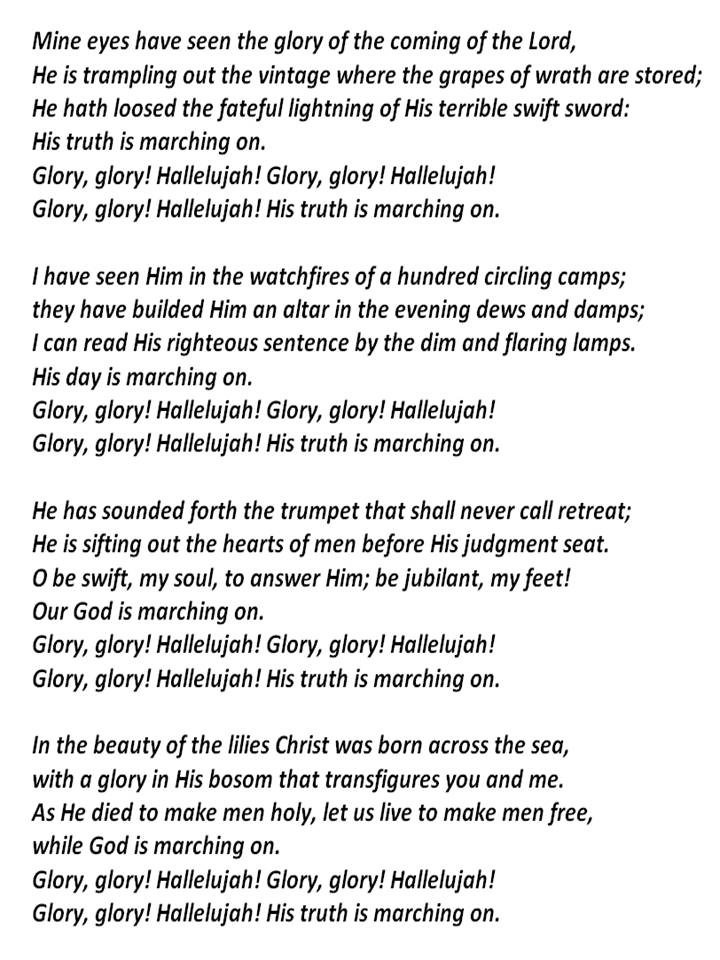
GLORY, GLORY! HALLELUJAH!

The Battle Hymn of the Republic is a hymn that became the semi-official Civil War song of the United States Army during that great civil conflict of our nation. It was written by Mrs. Julia Ward Howe, a poet and dedicated abolitionist, who visited an army camp near Washington D.C. in 1861. She was inspired by the soldiers singing “John Brown’s Body” which was a folk tune about an anti-slavery advocate who had been hanged for his efforts to free the slaves. Mrs. Howe felt that the catchy camp tune of this song should have better words along with it, and so she wrote her own lyrics to the same melody. The song expressed her support for Abraham Lincoln, who was elected President of the United Sates in 1860 and faced fierce opposition from the pro-slavery South.

Deeply anguished at the growing conflict between her fellow Americans, and in a desire to articulate her own feelings about the dreadful division of that time, Julia Ward Howe is said to have written her inspired verses almost without looking at the paper. The “Battle Hymn of the Republic” (a.k.a. “Mine Eyes Have Seen the Glory” and “Glory, Glory! Hallelujah!”) was first published in the Atlantic Monthly Magazine in 1862 as a battle song for the U.S. republic. Before long the entire nation became inspired by her text and united in singing the new words with the old tune.

I have to say, to have implicit trust in God’s faithful care and protection is never easy in times of danger or strife. Yet even in the midst of the terrible American Civil War between the United States and the Confederate States, a remarkable Christian woman named Julia Ward Howe proclaimed her confidence in God’s triumphant power for the ultimate good of all.

From the first time it was sung unto today, Mrs. Howe’s hymn has been acclaimed through the years as one of the finest national hymns of our United States of America. In fact, very early on it was sung as a solo at a large rally attended by President Abraham Lincoln himself. After the audience had responded with thunderous applause, the President (with tears in his eyes) cried out, “Sing it again!!” So it was sung again… And after more than a hundred and fifty years, patriotic Americans still join in singing with one voice, “Glory, glory! Hallelujah! His truth is marching on.”

May you all have a very happy Fourth of July and a deeply rejuvenating summertime!!!

Together in Christ, Pastor Tim