GOD’S GRACE & PRESENCE

There are two ways of living: one is the way of resisting Almighty God, and the other is the way of surrendering to God’s eternal grace and steadfast love. Resistance to God always brings anxiety and distress, restlessness and hopelessness. Surrender to God’s grace, however, brings inner peace and joy, true happiness and hope.

The worldly person is always in a state of resistance and inner conflict. The spiritual person, on the other hand, has given up the struggle through sweet surrender to God. For as St. Augustine famously stated in his autobiographical confessions, “You have made us for yourself, O Lord, and our heart is restless until it rests in you.”

Therefore, true religion is about surrender, and a wonderful symbolic representation of this is the California condor. When it steps out off the cliff, it simply stretches wide its wings and floats in the rising air thermals. Likewise, yielding to God’s baptismal grace by faith in Christ our Savior, we are thereby freed to no longer flap our spiritual wings to exhaustion. With the uplifting power of God’s Holy Spirit freely given us through the Word and Sacraments of Christ, we are free to float weightlessly on God’s unlimited atmosphere of grace and renewal.

“Even youths will faint and be weary, and the young will fall exhausted; but those who wait for the Lord shall renew their strength, they shall mount up with wings like eagles [and condors], they shall run and not be weary, they shall walk and not faint” (Isaiah 40:30-31).

So, very truly, all the weight in our hearts and minds can be tied in some way to our willful and sinful resistance to the free and unlimited grace of God in Jesus Christ. The more you fight God, the lower you fall. The more you yield and surrender to him, the lighter you become and the higher you soar spiritually.

The Season of Lent is all about dying to our sinful rebellion and rising up unto the abundant Life and Light and Love of Christ. For this is what our Lord Jesus Christ meant when he said, “Those who want to save their life will lose it, and those who lose their life for my sake will find it” (Matthew 16:25).

Consequently, as we move into Lent (meaning “length”) and the days lengthen toward Springtime, may we ever seek (by God’s grace) to give up the fight, surrendering to the forgiveness and renewal of the Lord our God given freely to us in Christ. Moreover, may we also be ever mindful of God’s Holy Presence with us and for us in the here and now, realizing that we stand spiritually before the amazing throne of the Eternal God each and every moment of our daily lives.

As the days lengthen and become warmer, may we come to understand more fully that the grass and flowers of the field, the trees and mountains, the rocks and rivers, as well as Christ’s Word and Sacraments, are altogether amazing means of God’s grace to us and for us. Truly, in/with/through Christ, we stand before the throne of God Most High right now… Right here and now, and forever… So, for this Lenten Season, and for the rest of our God-given life, may we remember our most Wonder-Full Lord God every single day, who is the ever-present Source of all creation and salvation, in whom “we live, move and have our being” (Acts 17:28a).

Blessed Lent to All of You!  Pastor Tim

FAITH FOR ALL SEASONS

We all know that as sure as Autumn gives way to Winter, so too, Winter will eventually give way to Spring, and in turn, Spring will give way to the warmth of Summer. The seasons of the year continue to cycle onward, and we know how to read the signs of these shifting seasons. In Luke 21:5-9, the disciples of Jesus puzzle over his words of warning (and hope) concerning the chaotic transitions of the seasons of history, which oftentimes demolish our various societal and institutional edifices that we cherish. To the disciples in Luke 21, the cherished splendor and symbolism of the Jerusalem Temple seemed so beautifully transcendent and so solidly permanent. Yet Jesus warned that it would all pass away — that “not one stone will be left upon another; all will be thrown down” [21:6] as he said.

Of course, this pronouncement of the Temple’s destruction completely puzzled the disciples, because, at that time, the rebuilding of the Holy Temple in Jerusalem was seen as a concrete sign that God was about to free his people and dwell with them again — just as in the days of the Ark of the Covenant and the entry of Israel into the Promised Land. Even the presence of John the Baptizer (a new prophet like the ancient Prophet Elijah) was something that raised expectations for the coming Messianic Age and Kingdom of God.

The stage was set for God to transform the world into his glorious Peaceable Reign — and God was doing exactly that, but not in the way everyone expected. In fact, God’s plan for humanity included his use of unexpected characters like King Herod and Pontius Pilate to accomplish his sovereign will. It also included unexpected events like Jesus’ suffering and Crucifixion. And, amazingly, it included unexpected events like Jesus’ Resurrection, his Ascension, and his sending of the Holy Spirit.

Consequently, in view of all these later unexpected events and mysteries, Jesus in Luke 21 said to his disciples (and to us), “By your endurance you will gain your souls” [21:19]. For as the old saying goes: It doesn’t matter what the future holds; what matters is Who holds the future. That is, our Lord and Savior holds our future in his hands — and not ours only, but also the future of the entire world and cosmos. So, in God alone we trust, and we endure by God’s grace granted us through his Word and Sacraments which create and strengthen true faith and new life within us.

God has an ultimate purpose and good future for his creation, and God is establishing his Kingdom in Christ no matter what unexpected turn of events might rattle us. For here’s the surprising paradox:  The new era of our Lord Jesus Christ did not start with a militant uprising of riotous mobs, but rather through the humble birth of a little child in Bethlehem, and through his later unexpected death on a cross. The Lord of Life was put to death, but death itself could not hold him.

Truly, the new age of Jesus Christ still comes through death and resurrection, and it comes to each of us through our Holy Baptism into the death and resurrection of Christ [see Romans 6:1-11]. Indeed, for all who are strengthened and kept by God’s grace in this dying and rising faith, we will gain our souls now and forever.

Therefore, we can view the seasons of conflict in our world with this divine perspective, placing our ultimate trust and hope in nothing and nobody other than the Crucified and Risen One, Christ the Son of God, our ever-present Lord and Savior. While continuing to pray for good order and healing during contentious times and conflicted seasons, we also continue to faithfully share the Word of God’s truth and grace (God’s law and gospel) for all people everywhere.

Glory be to the Father and to the Son and to the Holy Spirit, as it was in the beginning, is now, and ever shall be, world without end — Amen!

Grace & Peace, Pastor Tim

SOLA GRATIA

We who are Christians of the Lutheran Confession emphasize the gospel principle known as Sola Gratia, which means “Grace Alone” in Latin. This biblical truth and good news, highlighted by Martin Luther and subsequent Protestant Reformers, declares that we are saved from sin, death, and the devil, by God’s grace alone through faith in Jesus Christ.

For the Word of God within chapter 3 of the Epistle to the Romans proclaims the following… “But now, apart from the Torah, the righteousness of God has been disclosed, and is attested by the Torah and the Prophets — namely, the righteousness of God through faith in Jesus Christ for all who believe. For there is no distinction, since all have sinned and fall short of the glory of God; and all are now justified freely by his grace as a gift, through the redemption that is in Christ Jesus, whom God put forward as a sacrifice of atonement by his blood, effective through faith.” – (Romans 3:21-25)

Now, it’s important to note that this profound gift of Sola Gratia rests entirely upon a Savior who is simultaneously divine and human. That is, salvation by God’s grace alone completely hinges upon the person and work of Jesus Christ, who is both fully God and fully human. For only such a One as this could accomplish the atonement for our sins and reconcile us to God.

Jesus’ divinity (his being co-equal and co-eternal with God Almighty) ensures his sacrifice for us is of supreme value, atoning for all sin of all time, once and for all. As he is God incarnate in human flesh (true God from true God), the Eternal Son, of One Being with the Father, Jesus is the perfect offering of infinite worth, capable of redeeming all humanity. Simultaneously, however, his humanity is equally vital. As he is truly human, born of the Virgin Mary, Jesus lived a sinless human life under the biblical Torah, and he truly suffered and died in our place, bearing the penalty of our sins. So, only a fellow human could represent us and stand as our substitute, and, at the same time, only Almighty God could offer a sacrifice of eternal value that would be sufficient for the world’s redemption.

Therefore, this mystical reality (that Jesus Christ is fully God and fully human) makes our atonement and salvation possible. Christ’s atoning sacrifice, sealed by his blood shed for us and confirmed by his glorious resurrection, is the universal offering that reconciles us to God by grace alone.

For the Word of God within chapter 2 of the Epistle to the Ephesians states the following… “By grace you have been saved through faith, and this is not your own doing; it is the gift of God — not the result of works, so that no one may boast. For we are what he has made us, created in Christ Jesus for good works, which God prepared beforehand so that we may walk in them.” – (Ephesians 2:8-10)

Through Jesus’ death and resurrection, we are completely justified (completely forgiven!!!) before God, which perfectly reconciles us to God, all by God’s grace through faith as a free gift, not by our own works. But this is not to say that our good works don’t matter. In fact, good works are very much a part of our Christian faith. So yes, we are indeed saved by God’s grace alone through faith in Christ alone, not by our good works; however, we are saved by God’s grace in Christ for the sake of living a Christ-like life of good works as best we can — saved for doing good works as our way of life in response to God’s free grace given us (see Eph. 2:10 above).

Approximately six months ago, my newsletter article was about the 1700th Anniversary of the Nicene Creed in this Year of our Lord, 2025, and about how it is the preeminent statement of Christian faith which boldly professes that Jesus is “true God from true God, begotten, not made, of one Being with the Father… for us and for our salvation he came down from heaven, was incarnate of the Holy Spirit and the Virgin Mary, and became truly human.” Consequently, may we be firmly anchored in this true faith of our divine and human Redeemer, whose grace alone saves us.

Dear brothers and sisters, let us always rejoice in Sola Gratia (“Grace Alone”) trusting in the One Savior who is fully God and fully human — the One and Only who died for our sins, rose from the grave, secured our infinite atonement, and washes us in his baptismal waters of rebirth, renewal and eternal resurrection life.

For the Word of God within chapter 6 of the Epistle to the Romans declares the following…  “Do you not know that all of us who were baptized into Christ Jesus were baptized into his death? Therefore, we were buried with him by baptism into death, so that, just as Christ was raised from the dead by the glory of the Father, so we also might walk in newness of life. For if we have been united with him in a death like his, we will certainly be united with him in a resurrection like his.” – (Romans 6:3-5)

All thanks, praise and glory be to God for Sola Gratia!

By God’s Grace in Christ, Pastor Tim

SOLUS CHRISTUS

In Luke 12:35-40, our Lord Jesus talks about spiritual preparedness and faithful readiness — about staying faithful, staying awake, staying alert, because we don’t know the hour when the Son of God will come again to make all things new. In fact, Jesus says, “Be dressed ready for service and keep your lamps burning, like those waiting for their master to return…”

So, how do we stay “dressed ready” with our “lamps burning” when the world around us is shouting at us from every direction? How do we avoid getting tangled up in the lies and deceptions that surround us? How do we endure in true faith when the pressures of life and the noise of the culture try to lead us astray from Jesus Christ our Savior?

Well, the answer is the living and active Lamp of God’s Word within the Holy Scriptures that lights our path and keeps us from stumbling in the darkness of this world’s falsehoods. It’s trusting in the Word of God come what may, just like Abraham and Sarah, Zechariah and Elizabeth, and Joseph and Mary. That’s faith — trusting in what God says, even when the world says it’s foolish.

In Hebrews chapter 11, we hear about a kind of Faith Hall of Fame, listing those who lived by trusting in God’s Word, even when they couldn’t see the whole picture. They didn’t see the fulfillment of all God’s promises in their lifetime, but they kept their eyes on the “city with foundations, whose architect and builder is God” (Hebrews 11:10). They stayed faithful because they anchored their lives in what God had spoken, and that’s what we’re called into as we await the eventual return of Jesus our Lord.

But let’s be honest: There’s so much confusion, so many voices telling us what’s true, telling us what’s up and what’s down. For indeed, it’s spiritual warfare we’re engaged in! And our Lord Jesus warned us in Matthew 24 that many will come in the last days claiming to have the truth, with false teachers and deceivers trying to lead even God’s people astray.

Now, I have to confess that I consider myself to be a very ecumenical person. That is, I’m someone who respects and encourages interdenominational relations and cooperation within the Universal Church of Jesus Christ. In other words, I’m broadly supportive of Team Jesus in all its forms and expressions. In addition, I also consider myself to be generally affirming of interreligious dialogue, which means I’m supportive of conversation between the different religions of humanity for the purpose of mutual understanding and nonviolent coexistence. However, as a Christian of the Lutheran Confession, I am bound by conscience to the Word of God to always assert and freely declare the preeminent gospel truth that reconciliation and salvation with God comes in/with/through Christ alone — which is the Solus Christus of the Protestant Reformation. (Solus Christus is Latin for “Christ Alone.”)

Honestly, I really don’t like being controversial in my gospel proclamation, but the New Covenant gospel principle of Solus Christus will always be controversial no matter what, in all times and places. As a result, the following is some straightforward gospel controversy… Like the TV streaming platforms of Apple+, Disney+ and Paramount+, our fallen and sinful humanity will always prefer a “Christ+” belief (so to speak) over and above the gospel principle of Christ Alone. Consequently, throughout history we have seen attempt after attempt to uplift some sort of Christ+ theological scheme. There was the “Christ + good works” theology of the opponents of the Apostle Paul, as they tried to add our good works in cooperation with Christ’s atoning work for our salvation. But St. Paul, in no uncertain terms, completely and categorically rejected any idea of our ability to add anything to Christ’s work for our eternal salvation.

Not that our good works are bad, of course. In fact, good works are very much a part of our Christian faith. We are saved by God’s grace alone through faith in Christ alone, not by our good works; however, we are saved by God’s grace in Christ for the sake of living a Christ-like life of good works as best we can — for doing good works as our way of life in response to God’s free grace given us (see Ephesians 2:8-10).

Continuing on, there was also the “Christ + secret esoteric knowledge” of the ancient Gnostics, seeking to add secret spiritual knowledge to Christ for our salvation. But here’s where it gets even more controversial… Much later, in the Seventh Century AD, the “Christ + a Prophet” theology out of Arabia came along and insisted on the addition of the ministry of Muhammad for the salvation of the human race. Then fast-forward to the Nineteenth Century AD, when there arose yet another “Christ + a Prophet” theology that promoted the idea of an additional lost-and-found testament to Christ that had been buried away by an ancient American named Moroni. And then, during that same Nineteenth Century, in the Year of our Lord 1854, there was the “Christ + Mary” dogma of the Immaculate Conception of St. Mary, stating that Mary herself was born without sin — which arguably, and in all actuality, elevates Mary to the status of co-redeemer with Christ our Lord.

So, whether it’s Christ plus good works, or Christ plus a secret esoteric knowledge, or Christ plus some prophet, or Christ plus Mary, or Christ plus any other prophetic addition or unbiblical innovation, we are conscience-bound to the plain and precious gospel truth of Christ Alone. For there is only One who was born without sin: Christ alone. There is only One who is the Almighty God incarnate in human flesh: Christ alone. There is only One who conquered sin and death on our behalf: Christ alone. There is only One who is the Mediator between God and humanity: Christ alone. 

Therefore, regarding Christian faith and salvation? Regarding Christian justification and sanctification? Regarding Christian life and hope? All thanks, praise and glory be to God, because it’s CHRIST ALONE who bestows these all-surpassing gifts!

So again, how do we guard our hearts and stay on the right path? We cling to the Word of God within the Holy Scriptures. For indeed, when we read the Bible regularly, and when we explore it with others in small group Bible studies, then the Word of God within the pages of the Bible becomes a shield around our hearts, keeping our spiritual lamps full with the oil of the Holy Spirit, ready for the Great Day of our Master’s glorious Second Advent yet to come.

In these times of rampant deception, as we wait for the Lord’s return, let’s be a people who cling to the Word of God like all those in the Faith Hall of Fame found in Hebrews 11. The world may try to fool us, but God’s Word will never fail — for the Word of the Lord is our guiding light in the darkness, our spiritual sword and shield in these days. So, let’s keep ourselves in the Word — abide in it and know it well — and by God’s grace and Holy Spirit, it is Christ alone who will keep us firmly grounded in his truth and salvation unto the very end, and beyond the end.

Together in Christ,  Pastor Tim

CALLED TO WORSHIP & FELLOWSHIP

As believers and followers of Jesus Christ, our Christian faith is not meant to be lived in isolation. The Bible clearly emphasizes the importance of believers gathering in regular communal worship and actively participating in a local church fellowship. And as Lutherans, we confess that God has called us to live out our faith in community, gathering regularly for grace-filled worship and fellowship. Rooted in the Holy Scriptures and guided by the Lutheran Confessions, this call reflects God’s gracious design for his people to receive his good gifts, grow in faith, serve one another, and witness to Christ within our fallen and sinful world, united as the Body of Christ.

The Scriptures make clear that gathering together for worship is a divine command for believers. In Hebrews 10:24-25, we receive firm exhortation for this purpose, where it states the following: “And let us consider how to stir up one another to love and good works, not neglecting to meet together, as is the habit of some, but encouraging one another, and all the more as you see the Day [of the Lord’s return] drawing near.” This passage emphasizes the necessity of regular assembly, where believers receive God’s Word and Sacrament, and where they give one another mutual encouragement in faith, especially in view of Christ’s imminent Second Advent to come.

The Lutheran Confessions affirm this biblical mandate. The Augsburg Confession (Article VII) defines the Church as “the congregation of saints in which the gospel is purely taught and the sacraments are rightly administered.” Regular communal worship is the context where these powerful means of God’s grace (i.e., Christ’s Word and Sacrament) are faithfully delivered, sustaining and strengthening us in true faith and hope. In addition, we as Lutherans believe that the Lord himself is at work in our assemblies of worship forgiving sins, creating faith, and renewing his people through his gifts. And as we gather together in praise and prayer, we participate in a foretaste of the heavenly worship described in Revelation 5:9-14.

No Christian is meant to function alone. Our faith is not solitary but lived out in the context of a local church fellowship. We are baptized into the community of Jesus Christ where we depend on one another and serve with our God-given gifts. The Small Catechism teaches that the Holy Spirit “calls, gathers, enlightens and sanctifies the whole Christian Church on earth.” And this calling, gathering, enlightening, and sanctifying happens concretely in the local congregation, where believers hear the biblical Word of God proclaimed (both law and gospel). Moreover, the local church is also the place of mutual care and accountability. For Galatians 6:1-2 calls us to “bear one another’s burdens,” which requires active involvement in a fellowship where relationships foster love and support.

Faithful participation in a local church yields profound spiritual benefits. First, it anchors us in God’s grace. Second, it strengthens us to live out our various vocations of family, work, citizenship, and so on. Third, the local church is God’s primary instrument for mission. Jesus’ Great Commission (Matthew 28:19-20) is a corporate call, fulfilled as believers work together to evangelize, support missions, and amplifying our impact for God’s Kingdom. By being faithful members of our own congregation, Mount Olive Lutheran Church, we contribute to this work of the Kingdom.

Despite the clear biblical mandate, too many Christians at this present time neglect communal worship, citing their busyness or personal preferences, or their disillusionment with imperfect human organizations. Yet, Scripture warns against this in Hebrews 10:25, as isolation seriously weakens our faith and hinders our growth in Christ. While no congregation or organization of the Church of Jesus Christ is perfect, God nevertheless calls us to commit to a local congregational assembly and “to bear with one another in love” (Ephesians 4:2).

In our digital age, some may argue that online services or private devotions are sufficient. But while these digital and private alternatives can help supplement our faith, they cannot replace the embodied, relational nature of the Living Church of Christ gathered in the fellowship of the Holy Spirit. The biblical vision of divine worship involves physical presence, shared sacraments, and personal ministry — elements that virtual platforms cannot duplicate.

God commands his people to gather regularly for worship and to be faithful members of a congregational fellowship, because it is his design for our spiritual flourishing. As Lutherans we rejoice in this command and calling to prioritize corporate worship, engage actively in our congregation (including participation in one of our two small group Bible studies), and use our gifts to serve one another. So let us heed the call of Scripture: Do not neglect meeting together. And in this, we honor God, encourage one another, and prepare for the great “Day” when we will worship him forever in perfect fellowship and eternal joy.

Happy Summertime! Pastor Tim

BAPTISMAL EVANGELISM

I recently read the Epistle of First Peter, and the words “Baptism now saves you” really stood out to me (see 1 Peter 3:18-22). As a result, I’ve been thinking a lot recently about our commission and ministry from our Lord Jesus Christ to “Go and make disciples of all nations, baptizing them in the name of the Father and of the Son and of the Holy Spirit” (Matthew 28:18-20). And of course, our baptizing ministry to and for all peoples and nations is preferably done within the assembly of worship.

In worship, Christ is encountered. In the liturgy, Christ is present and self-giving, and he is ever-addressing his people. By the grace and power of the Holy Spirit, the Son of God is active and present through his Word and Sacraments. Consequently, a blessed assurance and confidence runs high within Lutheranism concerning the purpose of gospel proclamation and liturgical worship. In particular, according to the Word of God, Christ and his salvation are reliably encountered in Holy Baptism, in Holy Communion, and in the Holy Scriptures.

In the Old Testament, Psalm 105:1-6 declares the following… “O give thanks to the Lord, call on his name, make known his deeds among the peoples. Sing to him, sing praises to him; tell of all his wonderful works. Glory in his holy name; let the hearts of those who seek the Lord rejoice. Seek the Lord and his strength; seek his presence continually. Remember the wonderful works he has done, his miracles, and the judgments he has uttered, O offspring of his servant Abraham, children of Jacob, his chosen ones.”

In this biblical song of praise, the “deeds” that are to be made known to the “peoples” (i.e., the unbelieving Gentile nations) are referring to the deeds of God in and through his Covenant with Abraham, Isaac and Jacob. God’s great covenantal acts are to be made known to the nations, to both believers and unbelievers, through our shared liturgical life by “singing” and “praising” and “telling” and “remembering” God’s deeds of creation and salvation. And the purpose of such liturgical worship by the People of Israel was not merely for historical remembrance but for an encounter with the Lord God himself.

All of this is only intensified in the New Covenant. Our Lord Jesus performs his words, deeds, miracles and judgments in and through the worshiping assembly of his Church. In fact, Martin Luther comments on Psalm 105 by saying there are two things that belong to the true Christian believer: [1] The true believer has an illumined recognition of the Lord’s words and deeds (they have ears to hear and eyes to see the spiritual reality of things), and [2] The true believer has God-given affections for the Lord Jesus who is powerfully present in his Word and Sacraments. Therefore, liturgical worship is not merely a ‘style of worship’ but a whole theology of worship. Unbelievers hear the good news, and believers are conformed to the likeness of the Lord God whom they worship. In the liturgical assembly, Christ is present both to make disciples and to deepen discipleship. And it’s been said that the most solid and unwavering means of God-inspired, liturgical and missional activity comes by way of the Covenant of Holy Baptism.

In the great and global story of Christianity throughout the ages, neither door-to-door canvassing, nor tent revivals, nor even having stadium crusades have been the greatest vehicle of Christian evangelization. In every age of the Church of Jesus Christ, it’s Holy Baptism — particularly infant baptism — that has been the overwhelmingly greatest means of increasing, growing and expanding the Church globally. Since ancient days, Christians have babies and then bring those babies to Christ (in faith) to receive Christ’s saving Covenant of Holy Baptism, so that those infant children might one day grow to accept and affirm God’s baptismal grace and salvation for themselves by faith.

Through baptizing adults and children and infants alike, the Lord Jesus has built into the New Covenant of Holy Baptism an evangelistic feature that ensures the propagation of faith and salvation in which the Lord himself does all the saving work and receives all the glory. So, if we desire to see growth for congregations of the Church in our land, then every single one of us (both pastors and parishioners) would do well to ask people if they or their children have been baptized. And with this one simple evangelistic question, we will find that a great deal of gospel discussions will follow. In addition, we need to especially encourage married couples to bring their children to the waters of Holy Baptism.

A grace-filled theology and practice of Holy Baptism keeps the Church evangelistic and mission minded. Baptism is a mighty deed of the Lord, a miraculous act, and an absolving judgment — giving us much about which to praise and adore him. God’s grace in Christ alone fills our mouths with true praise, and our worship liturgy gives us the Bible-based words to do so. Furthermore, the evangelism of Holy Baptism is especially powerful when it takes place during our Sunday morning worship service, and it’s been too long (way too long) since the Sacrament of Holy Baptism has been administered at Mt. Olive.

I have to say that a lot of my best evangelistic moments have started with asking either of these simple questions: “Are you baptized?” and “Has your child been baptized?” So let us all commit to asking these simple evangelistic questions among the people of our relational circles more often. And let us always pray to God for guidance concerning who and when to ask these questions.

Together in Christ’s Mission, Pastor Tim

STEWARDSHIP & THE MIRACLE MAKER

In chapter 12 of the Gospel of Mark, Jesus addressed the subject of temple offerings. The following is from Mark 12:41-43…

He sat down opposite the treasury, and watched the crowd putting money into the treasury. Many rich people put in large sums. A poor widow came and put in two small copper coins, which are worth a penny. Then he called his disciples and said to them, “Truly I tell you, this poor widow has put in more than all those who are contributing to the treasury.”

Of course, Jesus is not saying that we should give to the work of God’s Kingdom to the point of financial hardship. Rather, he is saying that those who give out of their abundant wealth are not giving as much as those with far less wealth who give a lesser amount. In other words, Jesus is simply praising the generous spirit of the poor widow over and against the less generous spirit of the rich elite of Jerusalem.

While Jesus is not advocating for our impoverishment in Mark 12, he is certainly advocating for us to be as generous as possible (without material injury to ourselves) for the work of the ministry of God’s Kingdom for all people. Because of God’s unlimited grace for us in Christ Jesus our Lord, we are free to joyfully and cheerfully give whatever it is that we have pledged to the mission and ministry of our “temple” congregation, Mt. Olive Lutheran Church. For that’s what it says in Second Corinthians 9:7, where it says, “Each of you must give as you have made up your own mind, not reluctantly or under compulsion, for God loves a cheerful giver.”

ALL that we have and ALL that we are (absolutely everything) comes from God and belongs to God. From the Christian perspective, we are not owners but only stewards of all that the Creator gives to us — our lives, families, possessions, labor, income and talents. Therefore, everything that we have and everything that we are is to serve the glory of God for the sake of the world.

So, it’s not that we give a certain percentage to the work of God, and the rest is ours. No, it’s that 100% belongs to God, and we are to be good stewards of his 100%, including our offerings to our congregation. It is all from God anyway, and so it’s all in service of God’s Kingdom here in our earthly lives as a sweet foretaste of our heavenly lives to come. In other words, stewardship is everything we do after we say we believe. And stewardship is also the first things that we do. It’s the first fruits of our lives; the first fruits of everything.

“First fruits” means that we dedicate a certain amount of our time, talents and income to the work of God first thing — right off the top. For example, our Sunday worship service is the first fruits of our time each week, which is the morning of the very first day of the week. For another example, the Lord’s Prayer prayed each morning as we’re still sitting on the side of our bed (first thing) is a powerful first fruits practice. And of course, cheerfully giving a pledged amount of our income every pay period (first thing, right off the top) is a fundamental first fruits spiritual discipline.

Giving a set pledged amount to the work of God within our community of faith first thing off the top — rather than the last thing from the bottom dregs — is an act of worship that is multiplied by the offerings of others. As our Lord Jesus miraculously multiplied the loaves and fishes, we need to remember that it’s not for us to perform the miracle but it’s only for us to offer the five loaves and two fish. From everlasting to everlasting, the Lord God Almighty is the Miracle Maker and the Source of all that is, both seen and unseen.

Glory be to the Father and to the Son and to the Holy Spirit, as it was in the beginning, is now, and ever shall be, eternal world without end! Amen!

Together in Christ, Pastor Tim

PLANTING TREES

There is no doubt that we live in a time of colossal and world-shattering change: socially, religiously, culturally, nationally, globally, etcetera. It is indeed the end of the world as we know it.

Historians have recognized that approximately every five hundred years human civilization goes through some kind of major transition from an older structure of things to a new one, and it sure feels like that’s exactly what’s happening in our time. In fact, the last major civilizational shift was the Protestant Reformation, five hundred years ago, when Martin Luther and the other Protestant Reformers sparked this world-changing transfiguration through their reforms of the Medieval Roman Church.

Today, the world as we have known it is rapidly being replace by an emerging reality that is not yet fully clear. Consequently, speculations of the various end times theologies and ideologies abound. And due to the influential pre-millennial theology of the Left Behind novels, some Christians have started to regard any global peacemaking initiative as automatically some kind of great antichrist deception.

Consequently, such Christians (in the name of Jesus) often orient themselves against work for international peace and reconciliation because their Left Behind theology says that such work is always secretly on the side of the evil one. However, our Lord Jesus says, “Blessed are the peacemakers, for they will be called children of God” (Matthew 5:9). And when Martin Luther was asked what he would do today if he knew the world would end tomorrow, Luther said, “I would plant a tree.”

In other words, even if we knew that tomorrow the world was going to end and the Kingdom of God was going to come in its fullness, we are called to never stop planting “trees” today (both literally and metaphorically). That is, we are to especially plant the metaphorical trees of peace and truth and grace today, no matter what God has in store tomorrow.

God’s people are to always and continually take part in the creative and redeeming work of God today and every day! By the grace and power of God in Christ Jesus our Lord, we are to plant trees of faith in the midst of fear, trees of hope against all hope, and trees of righteousness and peace. And of course, we are to not forget to plant real trees that give us oxygen and help regulate the balance of life on God’s green Earth. Therefore, to prescribe and do anything other than this is to be “anti” (against) Christ.

As our Lord Jesus declares in Matthew 25:31-46, we are called to continue to labor to make the world a better place right up to the great Day of the Lord, the great Second Advent of Jesus Christ. By God’s grace, we are to continue to work (right up to the very moment of Christ’s return) to ease human suffering, to promote equal treatment under law, and, of course, to be peacemakers in the name of Yeshua (Jesus) our Eternal Savior.

Together in Christ, Pastor Tim

THE DIVINE MIRROR RESTORED

It’s true that we Lutherans certainly believe that the Lutheran branch of the Christian Faith has many wonderful gifts to offer to the whole of Christianity and indeed to the entire world, but we Lutherans also recognize that we do not have a monopoly on all theological and spiritual truths. And it’s true that we as Christians proclaim that the good news of Jesus Christ provides direct access to the fullness of God’s grace and truth, but we do not say that we have a monopoly on God’s eternal grace and truth. So if members of the Church of Jesus Christ consider those of other religions to be completely ignorant of all theological and spiritual truths, then this is just plain wrong. And if non-Christians assume that we Christians claim to be the sole purveyors of truth, then they’re wrong too.

Nevertheless, we Christians do profess and confess that Christ is “the Way and the Truth and the Life” (John 14:6), and so we earnestly proclaim the good news of his redeeming life, death and resurrection for the sake of the world. In fact, the Holy Scriptures exhort us to always be ready to share the grace and truth of Jesus Christ with our neighbors:

“So then, putting away falsehood, let all of us speak the truth [of Christ] to our neighbors, for we are members of one another.” – (Ephesians 4:25)

“But in your hearts revere Christ as Lord. Always be prepared to give an answer to everyone who asks you to give the reason for the hope that you have, but do this with gentleness and respect, keeping a clear conscience, so that those who speak maliciously against your good behavior in Christ may be ashamed of their slander.” – (First Peter 3:15-16)

However, we do this proclamation of Jesus’ good news within the multicultural context of human civilization. For we see throughout the history of salvation (from ancient times unto today) that there is a certain universal pattern we sinful human beings (of all times and places) seem to follow. It’s the pattern of faithfulness and apostasy, and it should be very familiar to us within the Christian Faith because the Holy Bible is filled with this pattern.

The cycle of faithfulness and apostasy is the historical pattern of civilization all over the world throughout the ages. From the very genesis of humanity, over and over again, God calls us, gathers us, instructs us and blesses us. But over and over again, people begin to reject and fall away from God’s revealed truth and grace. Therefore, God decided to send us the exact reflection of the glory of the fullness of himself — Christ Jesus our Lord, the Eternal Son of God and Bread of Heaven.

Let’s imagine that the revelation of God is one great Divine Mirror. And let’s imagine that the pattern of faithfulness and apostasy within human civilization is that Mirror breaking into a thousand pieces and scattering throughout the world. And then, after each shattering of this Mirror, a faithful remnant of believers were left to salvage as many pieces of God’s grace and truth as they could, resulting in a great diversity of faiths and spiritual traditions over time. So each time this shattering would happen in history, a group of like-minded believers would gather their particular shards of the Divine Mirror, and they would follow God’s Light reflected in these shards as best they knew how. And thousands of other groups did the same thing with the shards of truth they had collected.

But then, at the right time in human history, God revealed the fullness of his truth and grace for all people through the life, death and resurrection of Jesus Christ, who is the entire Divine Mirror restored to humanity — for he is the clear-as-glass Living Mirror of Heaven. And it might sound presumptuous to claim that the faith, hope and love of Jesus constitute the complete Divine Mirror reflecting the fullness of God’s Heart for humanity, but that is indeed what we have been granted in Jesus Christ our Lord. Thanks be to God!

However, while we have amazing access to the entire Divine Mirror of God (in all its clarity) through Jesus our Savior, this should not by any means negate the importance of the shards of God’s grace and truth that other religions have access to. In fact, the shards of Divine Truth within non-Christian religions (although incomplete) are nevertheless reflective of God’s saving truth. Consequently, the great non-Christian religious leaders of the world such as Buddha, Krishna, Muhammad, Confucius, and Lao-Tzu (as well as philosophers such as Socrates, Plato, and others) have all received pieces of God’s complete Mirror. They all have received a portion of God’s True Light — morsels of the Bread of Heaven (so to speak). So let’s genuinely appreciate the Truth of God from whichever direction it’s coming at us, even from non-Christian sources.

As we Christians share with others the fullness of God’s grace and truth in Christ Jesus our Lord, let’s remember the great Divine Mirror that every compassionate religion has pieces of — precious pieces of the universal reality and saving grace of God. Yet, our evangelical mission is to always uplift how all those shards of God’s Truth fit into the wholeness of God’s pure reflection in Jesus, the only begotten Son of God. And even if a certain non-Christian belief seems to be contrary to the gospel of Jesus, it just might be that this belief is still somehow based upon an eternal principle of God (if we look deeply enough). So maybe that shard of belief that seems to contradict Jesus simply needs a little ‘gospel windex’ to clarify it a bit.

Dear brothers and sisters in Christ, we’re not here to trash the pieces of the Mirror (or the portions of the Bread of Heaven) that people of other belief systems possess. We are simply here to do as it says in Ephesians 4 and First Peter 3, where it says: “let all of us speak the truth [of Christ] to our neighbors, for we are members of one another” and “be prepared to give an answer to everyone who asks you to give the reason for the hope that you have, but do this with gentleness and respect…”

Together in Christ, Pastor Tim

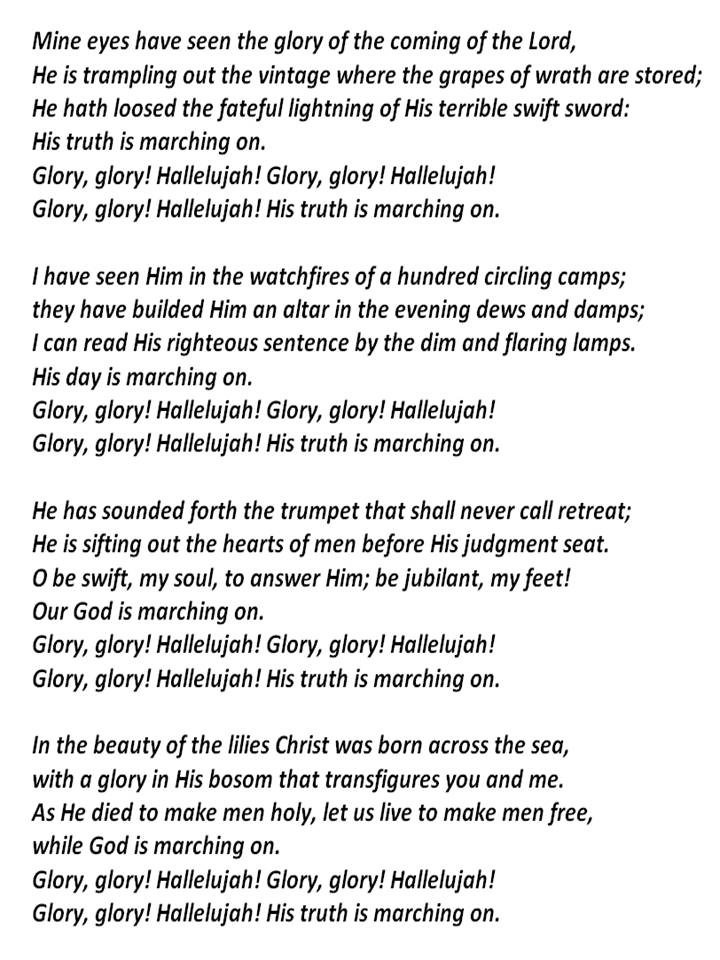
GLORY, GLORY! HALLELUJAH!

The Battle Hymn of the Republic is a hymn that became the semi-official Civil War song of the United States Army during that great civil conflict of our nation. It was written by Mrs. Julia Ward Howe, a poet and dedicated abolitionist, who visited an army camp near Washington D.C. in 1861. She was inspired by the soldiers singing “John Brown’s Body” which was a folk tune about an anti-slavery advocate who had been hanged for his efforts to free the slaves. Mrs. Howe felt that the catchy camp tune of this song should have better words along with it, and so she wrote her own lyrics to the same melody. The song expressed her support for Abraham Lincoln, who was elected President of the United Sates in 1860 and faced fierce opposition from the pro-slavery South.

Deeply anguished at the growing conflict between her fellow Americans, and in a desire to articulate her own feelings about the dreadful division of that time, Julia Ward Howe is said to have written her inspired verses almost without looking at the paper. The “Battle Hymn of the Republic” (a.k.a. “Mine Eyes Have Seen the Glory” and “Glory, Glory! Hallelujah!”) was first published in the Atlantic Monthly Magazine in 1862 as a battle song for the U.S. republic. Before long the entire nation became inspired by her text and united in singing the new words with the old tune.

I have to say, to have implicit trust in God’s faithful care and protection is never easy in times of danger or strife. Yet even in the midst of the terrible American Civil War between the United States and the Confederate States, a remarkable Christian woman named Julia Ward Howe proclaimed her confidence in God’s triumphant power for the ultimate good of all.

From the first time it was sung unto today, Mrs. Howe’s hymn has been acclaimed through the years as one of the finest national hymns of our United States of America. In fact, very early on it was sung as a solo at a large rally attended by President Abraham Lincoln himself. After the audience had responded with thunderous applause, the President (with tears in his eyes) cried out, “Sing it again!!” So it was sung again… And after more than a hundred and fifty years, patriotic Americans still join in singing with one voice, “Glory, glory! Hallelujah! His truth is marching on.”

May you all have a very happy Fourth of July and a deeply rejuvenating summertime!!!

Together in Christ, Pastor Tim